May 31, 2013

The Art of M.C. Escher

Maurits Cornelis Escher (1898 – 1972) was a famous Dutch graphic artist otherwise known as M.C. Escher. Uniquely left-handed like Leonardo and Michelangelo, his optical illusions, mind-boggling puzzles, and mathematically inspired woodcuts, mezzotints, and lithographs prints are still in high demand today.

 
(Escher, M.C. Ascending and Descending. c. 1960. lithograph)

Born in Leeuwarden in the Netherlands, Escher was the fourth child. His family moved to Arnhem, where he spent most of his childhood. His father, a working civil engineer, significantly influenced Escher's obsession with architecture and mathematics. Although incredibly intelligent, Escher failed all of his exams in high school and barely made it into the School for Architecture and Decorative Arts in Haarlem.

(Escher, M.C. Hand with Reflecting Sphere. c. 1935. lithograph)

However, his graphic art teacher, Samuel Jessurun de Mesquita, looked at his sketches and immediately encouraged him to continue with the visual arts. With only one week at the school, Escher informed his father that he would study graphic art instead of architecture.

(Escher, M.C. Sky and Water. c. 1938. woodcut)

Escher traveled to Italy after finishing school and was inspired by the countryside. He spent long hours drawing and sketching the designs for the various prints he would make after returning home. In addition to several trips to Italy, Escher also traveled through Switzerland and Spain. He met his wife in Italy in 1924, and they were both settled in Rome by 1935. As the rise of fascism became prominent, they moved to the Netherlands, where Escher spent the rest of his life.

 
(Escher, M.C. Belvedere. c. 1958. lithograph)

The patterns that were sculpted into the walls of the Alhambra, a fourteenth-century Moorish castle in Granada, Spain, and the tessellations found on the floors of the Italian basilicas and churches had a significant influence on Escher's work.

(Escher, M.C. Swans. c. 1938. woodcut)

Tessellations are created from repeating shapes covering a plane without gaps or overlaps. A reoccurring theme in Escher's later work. His artistic style is characterized by positive and negative shapes interacting together built around the concepts of infinity, unrealistic constructions, and architecture.

(Escher, M.C. Reptiles. c. 1943. lithograph)

Manipulated architecture, perspective drawing, and fantasy, Escher created his own unique worlds with meticulous detail, mathematically accurate but physically impossible, and his work is much appreciated here!

Enjoy! :)

References

February 5, 2013

The Art of Ferdinand-Victor-Eugène Delacroix

Ferdinand-Victor-Eugène Delacroix (1798 – 1863) was a famous French painter, draft-person, lithographer, writer, art critic but most of all, he was regarded as the leader of the French Romantic school. His masterpiece Liberty Leading the People, inspired by the French revolution, famously and truly embodied the French Romantic artistic ideals.


(Delacroix, Eugène. Liberty Leading the People. c. 1830. oil on canvas. Louvre Paris, France.)

Delacroix was born in Charenton Saint-Maurice near Paris. Orphaned at age 16, he became a massive follower of the Neoclassical painter Jacques-Louis David and a talented you artist. Early in his career, Delacroix received several coveted commissions for public buildings. He painted large, typical of the current Neoclassical style in vogue during this time. 


(Delacroix, Eugène. A Girl Seated in the Cemetery  c. 1823-1824. oil on canvas. Louvre, Paris, France.)

While his contemporaries drew inspiration from classical Greek themes and the Italian Renaissance painters who valued simplicity and calm grandeur. Delacroix was unique in that he was inspired by the brushwork of the famous Peter Paul Rubens, and he drew his inspiration from the Venetian Renaissance painters. They valued the sensuous and appealed to the viewer's emotions.

(Delacroix, Eugène. The Death of Sardanapalus. c. 1827. oil on canvas. Louvre, Paris, France.)

Delacroix eventually studied under the famous artist, Théodore Géricault. He even posed as one of the figures in the grand and famous Raft of Medusa masterpiece. After the painting's completion, he was deeply influenced by the effects of its magnitude, and he began to use his art to make bold statements that revolved around an emotional response. He even tackled scenes with severe violence. The "man versus nature" theme and the use of emotion became typical of the Romantic movement during its height from 1800 - 1840.

(Delacroix, Eugène. Portrait of a Turk in a Turban. c. 1826. pastel on paper. Louvre, Paris, France.)

Géricault's Raft of Medusa and Delacroix's Liberty Leading the People are two of the most famous pieces representing the French Romantic period. The Romantics' intent was to harness the power of imagination and take the viewer on an escape from their everyday lives. Romanticism was a counter-reaction to the industrial revolution and the past Age of Enlightenment.

“I do not care for reasonable painting at all. My turbulent mind needs agitation, needs to liberate itself. There is in me some black depth that must be appeased.”
-- Ferdinand-Victor-Eugène Delacroix
(Delacroix, Eugène. Arab Horseman Attacked by a Lion. c. 1849. oil on canvas. Art Institute of Chicago, Chicago, IL.) 

In 1832, Ambassador Charles de Mornay asked Delacroix to embark on a mission that would smooth over public relations with Morocco's Sultan Moulay Abd al-Rahman, and he couldn't refuse. He traveled through Spain, Tangiers, Algiers, and Morocco. He soon began painting architecture and the subjects he encountered in North Africa. The ancient, proud, and exotic culture moved him to write, "I am quite overwhelmed by what I have seen."

(Delacroix, Eugène. Arabs Skirmishing in the Mountains. c. 1863. oil on canvas. 
National Gallery of Art, Washington D.C.)

Delacroix's work was characterized by passion and color. Rather than utilizing the clarity of the outline or the carefully modeled forms of Neoclassicism, Delacroix used incredibly expressive brushwork to capture the energy and movement of his subjects. He became known as the "master of color" for his innovative color techniques, and his work eventually inspired the future French Impressionist movement.

If you ever can see one of Delacroix's original paintings in person, be sure to get up close and observe his unique brushwork. It will reveal the artistic genius, which is still revered even by today's contemporary art critiques, and his work is much appreciated here!

Enjoy! :)

October 21, 2012

The Art of Artemisia Gentileschi

Artemisia Gentileschi (1593 – 1656) was a female Italian Baroque painter in a time when women were not accepted as artists, and most were certainly not allowed to paint unless they lived in an Abbey. Today she is considered one of the most accomplished painters in the generation of artists who came after Caravaggio and is well known for painting courageous or strong-minded women from mythology.


(Gentileschi, Artemisia. Judith and Her Maidservant with the Head of Holofernes. c. 1625. 
oil on canvas. Detroit Institute of Arts.)

Gentileschi was born in Rome, her mother passed away when she was twelve. Her grieving father then unexpectedly took her on as his apprentice and taught her how to paint like a master. She was the daughter of Orazio Gentileschi, an accomplished painter, and talented artist. He introduced her to the famous artists of Rome of the time, including the infamous Caravaggio with whom he was close friends. Caravaggio casually stopped by their home to borrow props and perhaps even encouraged her to paint.


(Gentileschi, Artemisia. Self Portrait. c. 1638. oil on canvas. Royal Collection, Windsor.)

In 1611 when Artemisia was 18 years old, Agostino Tassi an artist, who worked with her father unfortunately secluded and raped her. When her father found out, he demanded justice and filed formal charges against Tassi for the injury and damage to his daughter's honor.


(Gentileschi, Artemisia. Judith Beheading Holofernes. c. 1611-12. oil on canvas. 
Museo Nationale di Capodimonte, Naples.)

The trial was horrendous and lasted over seventeen months Artemisia was physically tortured publicly in the courtroom to recant her statement and test the truth of her accusations with counter-accusations from Tassi that she was not a virgin, a whore, and a talentless painter. 

Tassi was finally convicted and sentenced to prison for the rape, but only served less than one year because he had connections with the pope.


(Gentileschi, Artemisia. Judith and her Maidservant. c. 1612-1613. 
oil on canvas. Galleria Palatina, Florence.)

During the trial and after, Gentileschi began to design and paint the story of Judith slaying Holofernes from the Bible. Judith was already a popular subject matter of the time, but Gentileschi’s portrayal of Judith is both original and has a unique perspective.


(Gentileschi, Artemisia. Penitent Magdalene. c. 1630. oil on canvas.)

Artemisia's style is characterized by "tenebrism," from the Italian word "tenebroso" (dark or gloomy), which describes a painting style where dark colors dominate over the light ones or the extreme contrasts of light and dark areas have dramatic illumination. 


(Gentileschi, Artemisia. Yael and Sisara. c. 1620. oil on canvas. Budapest, Szepmuveszeti Museum.)

In 1614, Gentileschi became the first official female member of the Academy of Fine Arts in Florence, which was only made possible by her most famous patron, the Grand Duke Cosimo II of the Medici family. Artemisia’s unusual liberties combined with her traumatic experience, allowed her to create some of the best chiaroscuro paintings of that time, and her work is much appreciated here!

Enjoy! :)

References 
  • King, R. Art. New York: DK Publishing. 2008.

September 30, 2012

The Art of Sandra Perlow

Sandra Perlow (1940 - present) is a contemporary abstract artist, currently living in Chicago, who has been creating art for over forty-five years. Sandra works in multi-media creating a collage on top of monoprints or woodcuts using a combination of various mediums which include acrylic, gouache, or oil stick.

(Perlow, Sandra. Must Come Again. c. 2012. collage on canvas.)

Sandra was born and raised in Chicago, Illinois where she earned her Bachelor’s of Art Education (B.A.E.) and her Master’s of Fine Art (M.A.) from the school of the art institute of Chicago in which she mainly focused on drawing and painting. She also received an M.A. from the Illinois Institute of Design. Perlow then began to teach herself at the school of the art institute of Chicago.

(Perlow, Sandra. Apart from That. c. 2012. collage on canvas.)

Rhythm is the key property of Perlow’s multi-media paintings. She works in shapes and colors, inspired by architecture or landscape. She draws inspiration from daily life, people, and museums.

(Perlow, Sandra. Tangled. c. 2012. collage on canvas.)

“Perlow’s creative process is an energetic shuffling and sorting of memory, text, sound, and image. There is spontaneity in her studio practice as the surrounding loop sets up a syncopated tempo as she works on several canvases at one time. The cacophony of visual signs is also found in the layers of images on her studio table: a landscape of books and papers from a visual library from Chinese brush painting Rotella’s decollates or the works of Philip Guston. The creative impulse is immediate and improvisational as Perlow pulls paper, motif, and gesture onto the surface of the picture plane.” (Sandra Perlow.net, 2012).

(Perlow, Sandra. Draw Into. c. 2012. collage on canvas.)

At the age of seventy-two years old, Sandra is full of energy, has a wonderful sense of humor, and has unparalleled lust for life, which I believe is definitely reflected in her work, and her work is much appreciated here.

Enjoy :)

References

May 31, 2012

The Art of Emil Carlsen

Soren Emil Carlsen (1853 – 1932) was a Danish born American Impressionist. He embodied the “starving artist” stereotype and was unfortunately not recognized for his talent as a painter until much later on in his career. Influenced by Jean-Baptiste-Siméon Chardin, Carlsen was famous for painting still life subjects and eventually became known as “The American Chardin”. Carlsen also served as a well-respected art teacher in Chicago, San Francisco, and New York for over 40 years.


(Carlsen, Emil. Iron Kettle and Clams. c. 1926. oil on canvas mounted on board. Private collection.)

Carlsen was from an artistic family and his family taught him how to paint. As a young adult, he studied architecture at the Royal Academy in Copenhagen for four years. After graduation, he got a job working in Chicago as an architectural draftsman but, he soon decided that he did not like the sedentary lifestyle, so he decided to become an artist. He then studied with the Danish marine artist Lauritz Holst and became the first teacher of drawing and painting at the Chicago Academy of Design.

(Carlsen, Emil. Teapot and Onion. oil on canvas. Private collection.)

Thirsty for more formal artistic training, Carlsen traveled to Paris where he first set eyes on the work of Jean-Baptiste-Siméon Chardin from the Rococo period in 1875. He then moved to New York and began to paint still life, similar to the work of Chardin but, he struggled to sell his work, so he taught classes at the Art Students League as well.


(Carlsen, Emil. The Fan. oil on canvas. Private collection.)

Carlsen was accepted into an exhibition of the Pennsylvania Academy of Fine Arts in 1883, where he finally was recognized for his talents. He was then offered a position as the director of the San Francisco Art Association’s School, so he moved to California in 1886. In 1904, he married and moved to a quiet town in Connecticut and painted until his death.

(Carlsen, Emil. The Wooded Interior. oil on panel. Private collection.)

Carlsen’s spacious compositions are timeless, elegant and display his excellent draughtsmanship. His soft flawless brushwork combined with the luminous qualities of paint create a tranquil atmospheric effect. His painting technique was meticulous and labor-intensive as he combined the effect of glazing (building up layers of thin paint) with scraping, painting, and then scraping again to build up a final impasto as the finale.

(Carlsen, Emil. Still Life with Oriental Works of Art. c. 1901. oil on board. Private collection.)

Carlsen was at first only recognized for his still life paintings but, later on, he was eventually recognized for his landscape and his marine paintings as well. There are very few books written about Carlsen, he is the unsung master whose paintings are now today scattered into the hands of many private collectors but, his work is very much appreciated here!

Enjoy! :)

References 

May 4, 2012

The Art of Manuel Orazi

Manuel Orazi (1860 – 1934) was an Italian painter, draughtsman, illustrator, and poster artist, who elevated a global philosophy in response to the beginning of the Industrial Revolution, the Art Nouveau movement. During this time, some artists welcomed technological progress while others condemned the poor quality of mass-produced machine-made goods. By applying the highest standards of craftsmanship and design to society’s everyday objects their aim was to elevate the decorative arts to the level of fine art.


(Orazi, Manuel. La Maison Moderne. c. 1902. lithograph.)

Orazi was born in Rome in 1860. By age twenty-three, he was already notable for designing the covers of sheet music, similar to modern-day album covers before the invention of the radio. He then moved to Paris in 1892 and worked as a newspaper, magazine, and book illustrator.


(Orazi, Manuel. Portrait of Sarah Bernhardt. c. 1895. lithograph.)

He illustrated periodicals for L’assiette au beurre and Le Figaro illustre and illustrated books by contemporary authors, including Edgar Allan Poe, Baudelaire, and Oscar Wilde. His poster designs for the opera and other Parisian theaters heightened his fame and he soon began to exhibit his work at the Salon des Artistes.


(Orazi, Manuel. L'Atlantide. lithograph.)

In 1896, he received the commission of his career and designed a poster for an art show at the Maison de l’Art Nouveau (House of Art) gallery. Initiated in 1895 by the German art dealer Samuel Bing, this gallery exclusively featured the modern art of its time.


(Orazi, Manuel. Hot Chocolate. oil on canvas.)

The show was coordinated in design and color installations of modern furniture, tapestries, and objets d’art (everyday objects of art). The objects from the show became so strongly associated with the Art Nouveau style that the name of his gallery subsequently provided a commonly used term for the entire movement and propelled Orazi’s career.


(Orazi, Manuel. Panneaux Decoratifs. c. 1900. lithograph)

He illustrated the novel, Aphrodite, by Pierre Louis in 1912 and after completing the illustrations for the novel, Les fleurs dumal by Baudelaire in Paris, he dies in 1934.


(Orazi, Manuel. Poster for Job Cigarette Paper. c. 1902. lithograph.)

Inspired by curved lines, nature, natural forms, and the structures of plants and flowers, Orazi embodied the Art Nouveau style and his work is much appreciated here!

Enjoy! :)

March 25, 2012

The Art of George Inness

George Inness (1825 – 1894) was an American painter, famous for his luminous and atmospheric landscapes. He helped define the Tonalist movement in the late 19th century. Tonalism was an artistic style that began in the 1880s. The name was formed based on a group of American painters who, painted landscape forms with one single color or an overall tone of colored atmosphere or mist.


(Inness, George. Sunset on a Meadow. date unknown. oil on canvas.)

Inness was the fifth of thirteen children born to a farmer and his wife in Newburgh, New York. Five years later his family moved to Newark, New Jersey. As a teenager, George studied under the painter, John Jesse Barker and then moved to New York City to work as a map engraver. He attended the National Academy of Design and began to study Asher B. Durand and Thomas Cole from the Hudson River School.


(Inness, George. The Storm. c. 1885. oil on canvas. Reynolda House Museum of American Art)

In 1851, a patron sponsored Inness to travel abroad, study and paint in Europe. During his trip to Paris, he discovered Camille Corot and the French Barbizon School. This group was focused on painting mood and shadow which influenced Inness to explore unique combinations of light and color, especially within specific color relationships. He published an article entitled, “Colours and Le Correspondences” where he described the spiritual significance of specific color combinations.


(Inness, George. Medfield Massachusetts. date unknown. oil on canvas. Private Collection.)

Inness used abstract shapes combined with soft edges to create a mystical experience for the viewer. As time went on his mystical view of nature became intensified. His artistic style is characterized by hazy atmospheres created by a distinctive tonal variety of neutral and saturated colors.


(Inness, George. Woodland Scene. date unknown. oil on canvas.)

Inness’ control over spatial relations, scale, drawing, and color combined with the idealistic handling of his subjects, allowed him to achieve a sense of relaxed and serene mystery, and his work is much appreciated here!

Enjoy! :)

References

February 24, 2012

The Art of Andrew Wyeth

Andrew Newell Wyeth (1917 – 2009) was part of the Regionalist movement and is most well known for his painting of Christina’s World, one of the best-known American paintings of the mid 20th century. In 1963, Wyeth was the first painter to receive the Presidential Medal of Freedom Award and at the age of 91 in 2007, he received the National Medal of Arts from George W. Bush.


(Wyeth, Andrew. Christina’s World. c. 1948. tempera on gessoed panel. Metropolitan Museum of Art, New York. ©)

Christina’s World depicts a young girl lying on the ground in an open field, looking up and crawling towards a grey house on the horizon. The girl was Andrew Wyeth’s neighbor, Christina Olson. She suffered from polio and had lost the use of her legs. Wyeth paints her painfully pulling herself up the hillside with her arms. The painting was purchased by the New York Metropolitan Museum of Art in 1948 and its opening, brought in record-breaking attendance.


(Wyeth, Andrew. Dodges Ridge. c. 1947. tempera on gessoed panel. Smithsonian American Art Museum.)

Wyeth says, “She was limited physically but by no means spiritually. The challenge was to do justice to her extraordinary conquest of a life which most people would consider hopeless.”


(Wyeth, Andrew. The Master’s Bedroom. c. 1965. watercolor. Andrew Wyeth Private Collection.)

Andrew’s father, Newell Convers Wyeth, also known as N.C. was one of the most famous and highest-paid illustrators in the United States in the early 20th century. He illustrated popular books such as Treasure Island, Robinson Crusoe, The Last of the Mohicans, and Robin Hood. Although Andrew had already mastered watercolor when he was about twelve years old, N.C. chose to tutor him extensively in art.


(Wyeth, Andrew. Winter. c. 1946. tempera on board. North Carolina Museum of Art.)

In 1945, Andrew’s life was forever changed after the tragic death of his father and nephew, who were both killed in a car accident at a railway crossing near his home in Chadds Ford. Andrew later describes that everything after that was different as though “his eyes were opened”.


(Wyeth, Andrew. Groundhog Day. c. 1959. tempera on masonite. Philadelphia Museum of Art.)

Wyeth painted with egg tempera, which is created from an egg yolk mixed with pigment. It is a unique medium to be used in the 20th century as its popularity declined after the invention of oil paint. Once mixed it cannot be stored and it dries rapidly but, it does allow for great precision and Andrew used this to his advantage as he worked countless hours to paint individual strains of hair and individual blades of grass in Christina's World.


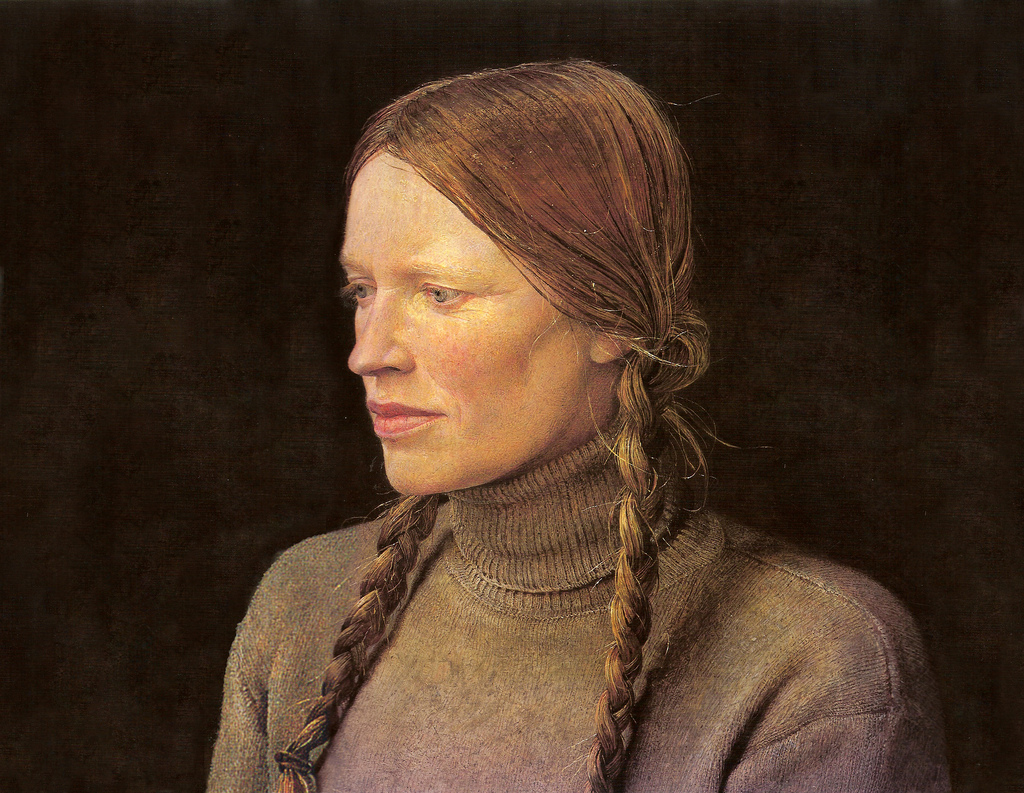
(Wyeth, Andrew. Braids. c. 1979. dry-brush watercolor. Private Collection.)

Wyeth’s paintings of open plains lacking vegetation, weathered buildings, and subjects of people in solitude seem to create a cold wintery feel and his work is much appreciated here! 

Enjoy! :) 

References

January 7, 2012

The Art of Dennis Miller Bunker

Dennis Miller Bunker (1861 – 1890) was one of the earliest painters in America to adopt the new innovative impressionistic style in the late nineteenth century. His career promptly spiraled up to the top of the art world and then came to a crashing halt, as he died unexpectedly from meningitis at the young age of twenty-nine. At the time of his death, he was well respected and personal friends with other legendary artists such as John Singer Sargent and Thomas Wilmer Dewing.


(Bunker, Dennis Miller. Pink Rose. c. 1886. oil on canvas.)

Bunker was born along with three sisters in New York City to a modest family of Quaker heritage. His father was the secretary and treasurer of the Union Ferry Company, which provided transportation between Brooklyn and Manhattan. Not a lot is known about Bunker’s childhood until he began to formally study art.


(Bunker, Dennis Miller. The Pool, Medfield. c. 1889. oil on canvas.)

In 1876 at the age of 15, Bunker joined the newly founded Arts Students League of New York and enrolled in New York’s Academy of Design. He was a quick study and he began to mature as a painter within only a few years. His work proved to provide great clarity with mesmerizing strength.


(Bunker, Dennis Miller. Tree. c. 1884. oil on canvas.)

Around 1880, Boat pictures and landscapes were selling at the time and Bunker was keenly aware of the art marketplace. He began to focus on painting marine subjects, mostly boats at low tide and so he sold well. He soon moved into figures and landscapes, although when he couldn’t afford to pay for a model he painted flowers.


(Bunker, Dennis Miller. Jessica. c. 1890. oil on canvas.)

Bunker left New York to study abroad. He traveled to Paris and enrolled in the Ecole des Beaux-Arts which was a very prestigious art school. It had an extremely rigorous training program and it gave him the perfect credibility to become an art teacher at a young age when he returned to America.


(Bunker, Dennis Miller. Cottage. c. 1889. oil on canvas.)

At the youthful age of twenty-four, Bunker began teaching at the Cowles Art School in Boston. He taught cast drawing, artistic anatomy, and composition. That same year, he was given his first solo exhibit at Noyes and Blakeslee Gallery, which opened unimaginable opportunities for him.


(Bunker, Dennis Miller. Yellow Rose. c. 1887. oil on canvas. museum.)

Bunker’s work is highly memorable for its individuality and force. In its limited use of color, alluring modeling of form and aesthetic elegance, Bunker’s captivating and unusual paintings successfully make the perfect balance between abstraction and representation, and his work is much appreciated here!

Enjoy! :)

References

  • Hirshler, E. Dennis Miller Bunker, An American Impressionist. Boston: Museum of Fine Arts, Boston. 1994.

November 24, 2011

The Art of Jackson Pollock

Jackson Pollock (1912 – 1956) was born in Cody, Wyoming. He was one of the first American painters to become an international star and he lived up to the “rock star” reputation by living recklessly and drinking excessively. He was famed for his notorious drip paintings, including his nickname from Time magazine as “Jack the Dripper”.


(Pollock, Jackson. Blue Poles, Number 11. c. 1952. oil on canvas. National Gallery of Australia, Canberra.)

In his youth, Pollock studied traditional art at the Manual Arts High School in Los Angeles. He then moved to New York and studied at the Art Students League under Thomas Hart Benton from 1929 to 1942. Soon after, he leaned toward the surrealistic style. His early work had very expressionistic strokes but, he became more interested in the act of painting itself. This action then became the subject matter as an expression of his isolation in the modern world.


(Pollock, Jackson. Eyes in the Heat. c. 1946. oil on canvas. Peggy Guggenheim Collection, Venice.)

Pollock began making his drip paintings in 1947. They established his reputation and completely revolutionized the process by which a painting was supposed to be made. Instead of using an easel, he laid the canvas on the floor. He then moved over the canvas and splattered or dripped paint onto it, sometimes directly from the tube or can. Instead of using brushes, he dripped the paint from a stick, poured it, flung it, or smeared it. He also used strange objects to scratch into the surface or to create a thick crust of paint.


(Pollock, Jackson. Lavender Mist, Number 1. c. 1950. oil on canvas. National Gallery of Art, Washington D.C.)

Pollock soon became a leader in the Action Painting and Abstract Expressionism movements as he paved the way for other artists to express themselves in this style. He also revolutionized the idea of composition by creating pieces that had no focal point. No one shape or object was the main focus, he treated the edges and the center the same as if all parts of the painting were equal. They were pieces as Pollock said, with “no beginning or end”.

(Pollock, Jackson. Convergence. c. 1952. oil on canvas. Albright Knox Gallery, Buffalo, N.Y.)

Pollock’s career was cut short by his untimely death when he died in an automobile accident but, he main a colossal impact. He turned the art world on its ear both in the United States and in Europe, forcing western society to once again as the question of “What defines a Piece of Art?” and his work is much appreciated here!

Enjoy! :) 

Reference:

  • King, R. Art. New York: DK Publishing. 2008.